The companion site · 18 chapters · 13 verdicts · 159 key concepts
AI Assisted Software Engineering
Build Better Software with Human Creativity and AI
Coding agents now write much of the code. Someone still has to decide what to build, estimate it, manage its risks, review it, control its changes and know whether it works. This textbook teaches each classical method from its foundation, then tests it with an assumption audit: what still holds, what to recalibrate, what breaks and what inverts.
One method for every chapter
The assumption audit
- 1Method
- 2Assumption
- 3Evidence
- 4Verdict
- 5Replacement
- 6Prediction
Then one more question: what would have to change about agents for this conclusion to stop being true? How the audit works →
Thirteen audits, four verdicts
Two hold, five recalibrate, four break, two invert
2 chapters
Holds
The assumption still describes agent work. The method stands as taught.
8. Coordination at Scale10. Design for Change, and for Agents
5 chapters
Recalibrate
The method survives with new parameters, rates, thresholds or a redefined quantity.
3. Life-Cycle Models When Iteration Is Cheap7. Project Management and Where Value Is Earned9. Risk Management12. Reviews13. Testing, Evaluation, and Tests as Steering
4 chapters
Breaks
The method needs new variables, records or steps. Changing its numbers is not enough.
5. Size Estimation6. Cost and Schedule Estimation After COCOMO14. Configuration Management When Agents Commit15. Reliability of Nondeterministic Systems
2 chapters
Inverts
The activity's purpose was set by a scarcity that has reversed. What was cheap is now scarce.
4. Requirements as the Primary Artifact11. Construction When Code Is Cheap
The count summarizes the judgments; it measures nothing. Each verdict is dated, names the assumption it tested, and ends with a prediction your own project data can check.
The book

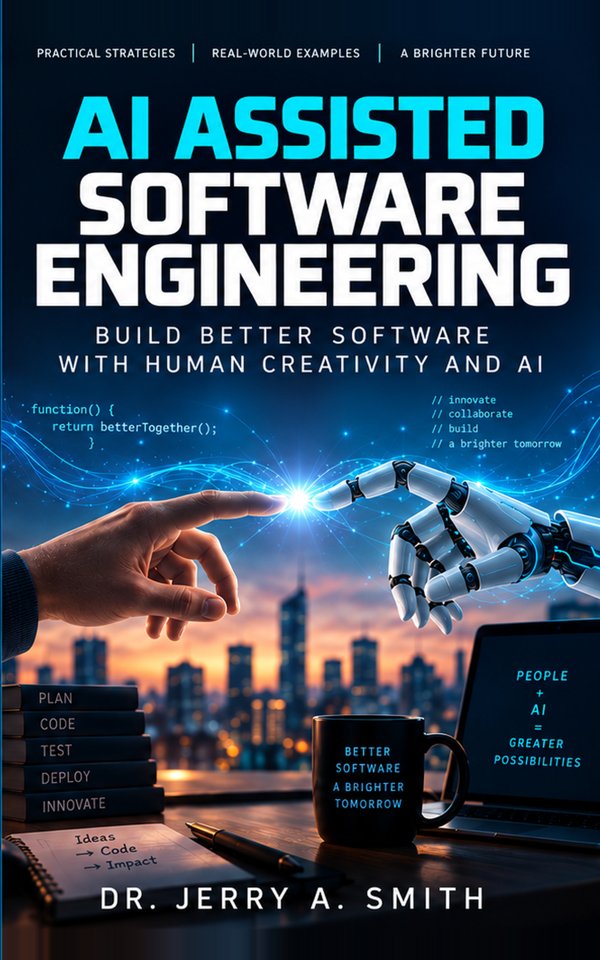
AI Assisted Software Engineering: Build Better Software with Human Creativity and AI, by Dr. Jerry A. Smith. 602 pages in four parts: 18 chapters and eight appendices, with a running example (Dispatch, a small dispatch dashboard) and a semester project in which each student manages a team of agents and inherits a classmate's project halfway through.